I was going to write a blog post about AI and Jevons Paradox.
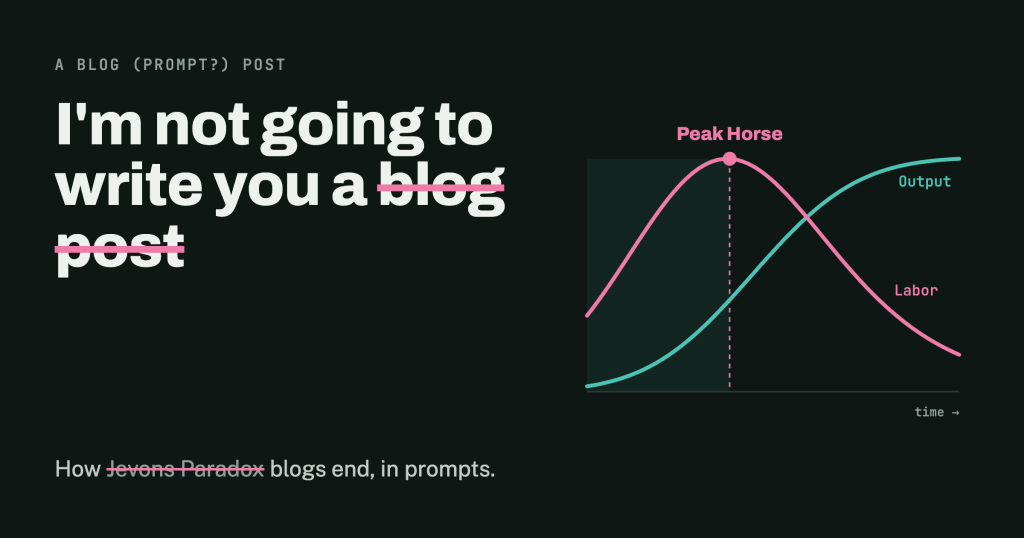
These days everyone talks about Jevons Paradox but few point out that it’s temporary. It always ends, usually in one of eight ways, and rarely does the Peak Horse see it coming.
I was going to explain all that but then I realized, “Why bother?”. It’s probably better for AI to explain it interactively than getting a wall of text from me.
So instead paste this prompt into your daily driver AI and ask it questions on what you don’t understand:
Everyone talks about Jevons paradox and AI, but it's a moment in time, not something that lasts forever. Teach me how Jevons paradoxes typically end.

Hold a strict bar: only call something Jevons if total consumption of the input (compute, labor, attention, capital) rises, not just usage.

Use these eight endings, grouped by what turns:

DEMAND TURNS
- Saturation: people have enough. (Lighting: price fell ~3,000x in Britain 1800–2000, then demand stopped responding. Cloth: "full closets.")
- Substitution: demand stays, a new technology serves it. (British coal → oil and gas. Horses → tractors. Tape recorders → computer recording.)

SUPPLY TURNS
- Depletion: the input runs out. (Oil fields, the Hubbert peak. Jevons feared this for coal; it didn't happen.)
- Bottleneck: a different, complementary input becomes the cap.

CAPITAL TURNS
- Overshoot: capacity is built faster than demand grows; builders go bust, and later users inherit cheap capacity. (1990s dark fiber. 1840s British Railway Mania.)

THE BYPRODUCT TURNS
- Decoupling: output grows while the byproduct falls.
- Prohibition: a rule caps the activity. (CFCs under the Montreal Protocol. Leaded gasoline.)

ACCESS TURNS
- Enclosure: cheap production floods a shared resource, usually attention, and its owner closes the gate. (Spam filters. Open-source projects shutting AI-flooded bug bounties.)

KEY PATTERN: LABOR TYPICALLY PEAKS, THEN FALLS, LONG BEFORE OUTPUT DOES. This makes it hard to know when "Peak Horse" hits. Examples: US coal mining jobs peaked in 1923; coal production peaked in 2008. Horse numbers grew sixfold through the railroad era, and early tractors were complements before they became substitutes.
I was going to close with takeaways and lessons for the reader. But again, the AI that knows you personally will do that better too. So finish with this prompt:
Now apply this framework to me. Use what you know about me; if you don't know enough, first ask me up to three questions about my role, what my work actually consists of, and my time horizon.

1. Which endings are most likely for my field specifically, and how does that differ from AI broadly?
2. Break my work into its main tasks. For each, say whether AI is currently a complement or a substitute, and how close it is to Peak Horse.
3. What early signals should I watch in my own work that would tell me an ending is arriving?
4. Strategic moves (1–3 years) and tactical moves (next 90 days) I should consider.

If you can create artifacts, build a map of my tasks on two axes: AI complements me → AI substitutes for me (across), and hard → easy to verify the result (up). Easily verified work tends to get automated first, so label the top-right corner "Peak Horse zone."

Be direct, skip reassurance, and flag where you're speculating.
Hope you enjoyed this blog (prompt?) post. Notice what happened here. This is just the latest step in decades of content getting steadily cheaper to create. But the total time we spend consuming it already peaked around 2024. Which Jevons Paradox ending are we in?